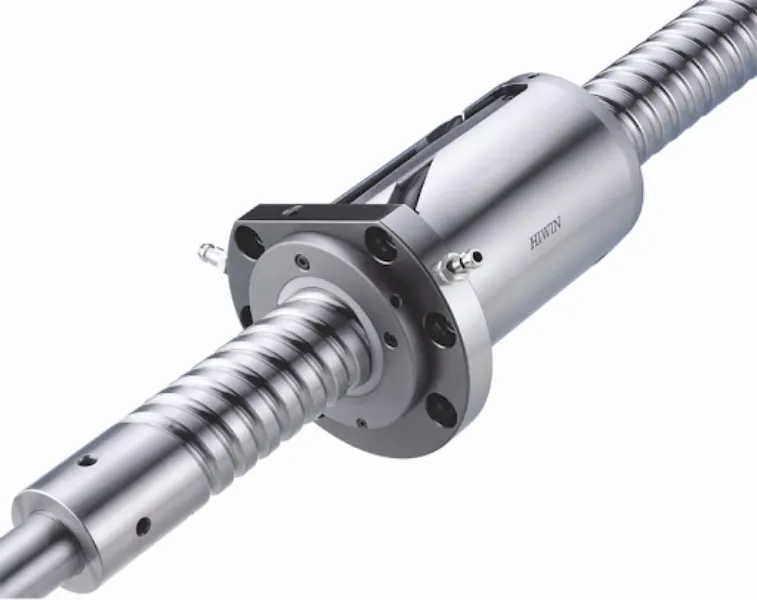
When an industrial machine depends on accurate linear movement, the screw mechanism deserves careful attention. Ballscrews are widely used in automated equipment because they convert rotary motion into linear travel using recirculating rolling elements.
However, buying a replacement or specifying a new ballscrew without sufficient application information can lead to expensive compatibility problems.
Identify the Required Screw Characteristics
Procurement teams should avoid sending only an approximate length and diameter when requesting a quotation.
Useful technical information includes:
- Nominal screw diameter
- Lead
- Overall length
- Threaded length
- Nut configuration
- Accuracy requirement
- Shaft-end machining
- Mounting arrangement
- Operating speed
- Axial load
- Required travel
- Lubrication conditions
For replacements, drawings and existing component markings can significantly improve identification.
Understand Why Lead Matters
The screw lead determines the linear distance travelled for each revolution.
This affects speed, motor requirements, resolution, and the overall motion profile. Substituting a screw with a different lead can change machine behaviour even if the physical diameter appears correct.
For this reason, dimensional similarity does not guarantee functional interchangeability.
Check the Support Arrangement
A ballscrew operates together with support bearings, couplings, guides, and the drive system.
If the replacement screw does not match the existing end-support arrangement, installation may require additional machining or component changes.
Engineers should therefore review Ballscrews together with their fixed-side and support-side components.
Alignment is equally important. A new screw installed into a misaligned mechanical system may experience abnormal loading and fail to provide the expected performance.
Consider the Actual Duty Cycle
An axis that moves occasionally has different requirements from one completing thousands of cycles during production.
Speed, acceleration, load, stroke, and operating hours should be included in the selection process. Machine builders should also consider critical speed and buckling conditions where applicable, particularly for longer screws.
Contamination and lubrication requirements need attention in demanding industrial environments.
Selecting a Supplier With Application Understanding
For manufacturing companies and OEMs in Bengaluru, availability is important, but technical compatibility is equally significant.
OLE Automation Inc supports industrial motion, automation, and engineering requirements for machine-building and maintenance applications in Bengaluru. Buyers approaching a provider for Ballscrews should ideally have application specifications, drawings, machine information, and existing part identification ready.
A supplier conversation becomes much more productive when the requirement is described in engineering terms rather than simply asking for 'the same size.'
Before finalizing an order, confirm the screw dimensions, lead, nut arrangement, shaft ends, support compatibility, expected load, required accuracy, and operating conditions.
This preparation can reduce procurement errors and help ensure that the selected component integrates correctly with the machine's motor, support bearings, guideways, and control architecture.
Keywords